Roobet KYC: verification triggers, documents and withdrawal impact
 Available in GB
Roobet can request KYC and restrict services such as deposits and withdrawals until identification is complete. Its current Level 2 Verification guidance accepts a passport, driving licence or government-issued identification document. It also says documents are reviewed manually and that the compliance team will contact the user if more is needed, but it does not give a guaranteed processing time.
The practical lesson is to prepare clean, current identity evidence and to treat verification as an account-control process rather than an instant checkpoint. KYC can affect when funds are available for withdrawal, but it is separate from payment-network or blockchain delays that may occur after a withdrawal has been approved and sent.
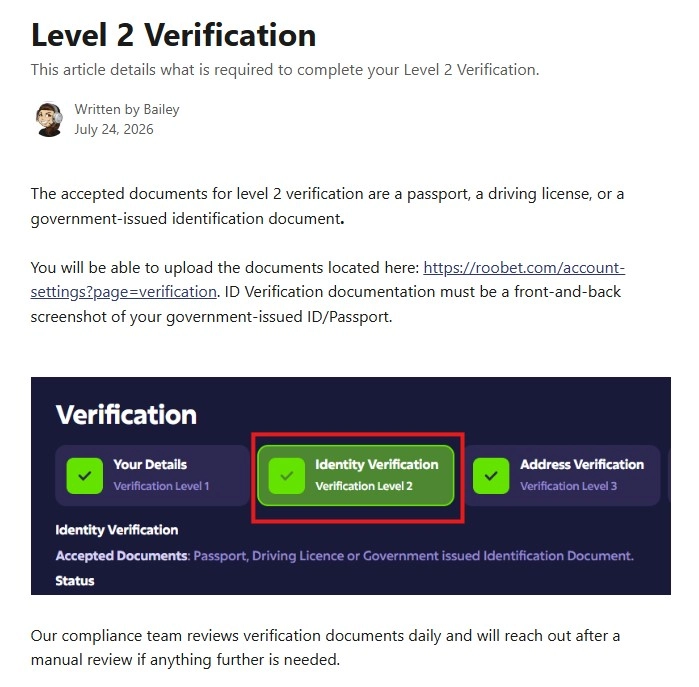
Table of Contents
- Roobet can ask for KYC at any time
- Currently verified Level 2 identity documents
- Document quality can prevent avoidable review loops
- KYC can affect withdrawals, but not every delay is KYC
- Deposit turnover is another separate withdrawal condition
- KYC should be treated as part of account security
- UK readers should separate verification from eligibility
- What to do when a verification request appears
- How to reduce avoidable friction when Roobet asks for verification
Roobet can ask for KYC at any time
Roobet’s current Terms say it may request KYC documentation at any time to determine identity and location. The same clause says services such as deposits and withdrawals can be restricted until the identification process is completed and requested information has been provided.
That wording matters because it rules out the common assumption that verification happens only at signup or only after a specific withdrawal threshold. A user may encounter it at a different point in the account lifecycle, so preparation is more useful than trying to predict an exact trigger.
Verification times can vary
Roobet says its compliance team reviews documents and follows up if more is needed. The current public guidance does not promise an exact completion time.
Currently verified Level 2 identity documents
Roobet’s Level 2 Verification article currently lists three accepted identity-document categories. Keeping the list limited to what the operator actually publishes is important because KYC pages often become inaccurate when they add assumed utility bills, bank statements or country-specific documents without a current source.
| Document type | Currently listed by Roobet | Preparation focus |
|---|---|---|
| Passport | Yes | Use a clear, current image with all required details readable. |
| Driving licence | Yes | Capture the required sides cleanly and avoid glare or cropped edges. |
| Government-issued ID | Yes | Use the official identity document rather than an informal substitute. |
The article says ID verification documentation must include front-and-back images for the government-issued ID or passport flow it describes. Because exact requirements can change, use the current verification screen and help article at the point you are asked to verify rather than relying on older instructions.
Document quality can prevent avoidable review loops
You cannot control how long a compliance review takes, but you can avoid obvious image-quality problems. Use a well-lit image, keep the whole document visible, make sure text is readable, and avoid reflections across names, dates or document numbers. Do not digitally alter the document or obscure information unless the verification interface explicitly tells you to do so.
Consistency also matters. Roobet’s Terms require registration information to be true, current and correct. If the account data and identity evidence conflict, the issue is not solved by repeatedly uploading different images. Correct the underlying account information through the proper route and follow the compliance team’s instructions.
- Use one of the document categories currently accepted by Roobet.
- Check expiry and legibility before uploading.
- Capture all required sides without cropping corners.
- Avoid glare, blur and heavy compression.
- Use the designated verification flow rather than sending identity files through casual support chat.
KYC can affect withdrawals, but not every delay is KYC
Roobet’s Terms allow it to refuse withdrawals until identity is fully verified and requested information is supplied. That makes verification a genuine withdrawal dependency. It does not mean every delayed cash-out is a compliance review.
Crypto withdrawals, for example, can also depend on blockchain confirmations. Roobet’s current help material says receipt timing can vary with network confirmation even after the operator sends a transaction. The Roobet withdrawals separates those payment-network issues from account verification.
Two different clocks
KYC review is an account/compliance process. Blockchain or payment settlement is a network/process issue. Treating them as the same problem leads to the wrong troubleshooting steps.
Deposit turnover is another separate withdrawal condition
Roobet’s current AML guidance says deposits must be wagered 100% before withdrawal. This requirement is separate from KYC: completing identity verification does not automatically satisfy deposit turnover, and completing turnover does not remove the possibility of a verification request.
That distinction is useful when diagnosing a blocked withdrawal. First identify whether the account is waiting for identity verification, whether the deposit turnover condition has been met, or whether a payment network is still processing the transaction. Combining all three into a vague “withdrawal problem” makes support conversations slower and less precise.
KYC should be treated as part of account security
Identity verification is often discussed only as friction, but it also intersects with account ownership. A verified identity can help distinguish the legitimate account holder from someone who has obtained login credentials. That does not make KYC a substitute for a strong password or two-factor authentication.
The broader Roobet account guide covers 2FA, live support and responsible-gambling controls. The useful sequence is to secure the account first, keep registration data accurate, and be ready for verification if Roobet requests it.
UK readers should separate verification from eligibility
KYC proves identity and location; it does not create permission to use a service from a restricted jurisdiction. Roobet’s current restricted-regions guidance lists the United Kingdom among territories whose residents may not access the website or register an account. A successful identity check therefore should never be interpreted as evidence of UK regulatory approval or general UK availability.
For the wider licensing and operator-risk context, see our Roobet safety. That page keeps licensing questions separate from the narrower issue of what documents Roobet may request from an account holder.
What to do when a verification request appears
- Read the current request carefully and identify which verification level or document type is being asked for.
- Use the current official verification interface, not an old bookmark or third-party upload link.
- Prepare the requested identity document with clear, complete images.
- Check that account details are current and consistent with the document.
- Submit once through the designated flow and wait for the compliance response rather than creating duplicate submissions.
- If the interface shows a specific error, contact support with the error details but do not share passwords or 2FA recovery secrets.
For the full product context before interpreting any KYC request, the Roobet UK review explains how account, payment and UK regulatory issues fit together.
How to reduce avoidable friction when Roobet asks for verification
The best preparation is simple: keep account information accurate, use a current accepted ID, submit clear images through the official verification flow and avoid assuming a guaranteed turnaround time. If a withdrawal is also involved, separately check deposit turnover and payment-network status so you know which condition is actually holding up the process.
Roobet’s current Level 2 guidance gives a short, specific document list and says compliance reviews the submission manually. Staying within those published facts is more useful than promising “instant KYC” or adding document requirements that Roobet has not currently stated.
A useful way to handle a verification request is to separate what you know from what you still need Roobet to confirm. You know that the operator can ask for KYC at different points in the account lifecycle, that deposit and withdrawal functions can be restricted while identification is incomplete, and that the currently published Level 2 list includes a passport, driving licence or government-issued ID. What you should not assume is the exact trigger, a guaranteed review time or an extra document requirement that does not appear in the current request.
If a verification request appears while you are trying to withdraw, read the account status before changing payment details or submitting the same document again. The withdrawal may be waiting on identity review, the separate 100% deposit-turnover condition, or an external payment stage. Identifying which condition is active helps you avoid treating every delay as a KYC problem and gives support a clearer description if you need assistance.
The same approach applies to document preparation. Match the document to the category Roobet is currently asking for, make every required side readable, and check that the personal details on the account are current. A clearer submission does not create a guaranteed turnaround time, but it reduces avoidable problems such as unreadable text, missing edges or inconsistent account information. If Roobet asks for something beyond the published Level 2 examples, follow the request shown in the official verification flow rather than relying on an old third-party checklist.
Finally, keep verification and UK access as separate questions. Completing identity checks confirms information about the account holder; it does not change Roobet’s stated restrictions or create UK regulatory approval. For a UK reader, that distinction matters just as much as the document list itself. The safest reading of a completed KYC step is simply that one account-control requirement has been satisfied, not that every withdrawal, payment or jurisdiction question has also been resolved.
Written by the editors at Roobet Casino.